Glasfabriek – Schiedam
In the heart of Schiedam, a new residential district is emerging where living and landscape are inseparably connected. A low-traffic urban environment with the Glaspark as the defining framework for the area’s transformation.
Living in the Park
What was once a closed industrial site is evolving into a diverse urban neighbourhood with a distinctive identity, where the harbour and the city meet. Between the development plots, a continuous green framework takes shape, anchoring the site’s industrial heritage while creating space for future growth. Rather than a collection of individual buildings set within a park, it is a coherent landscape where living, movement, ecology, and urban life come together.
The landscape is organised around one clear principle: living within the park, not merely alongside it. Water, greenery, everyday use, and slow mobility together form the collective foundation of the new neighbourhood. The park is not conceived as a fixed end-state, but as a robust and adaptive system that evolves over time, responds to climate conditions, and accommodates changing patterns of use.
A Water Landscape for Climate Adaptation
At the heart of the plan lies a visible water landscape, where bioswales capture rainwater and make seasonal dynamics tangible. Water is not hidden away but becomes part of everyday life. It creates opportunities for gathering, play, and recreation, while simultaneously strengthening the area’s climate resilience. The result is a landscape that not only performs during periods of extreme rainfall and drought but also makes these processes visible and experienceable.
Around this green-blue core, a loose and informal network of routes, open spaces, and places to stay unfolds. Existing structures remain recognisable and are given new meaning within the park. Open and enclosed spaces alternate, creating rhythm, diversity, and intimacy throughout the area. The landscape does not feel rigidly designed, but naturally evolved.
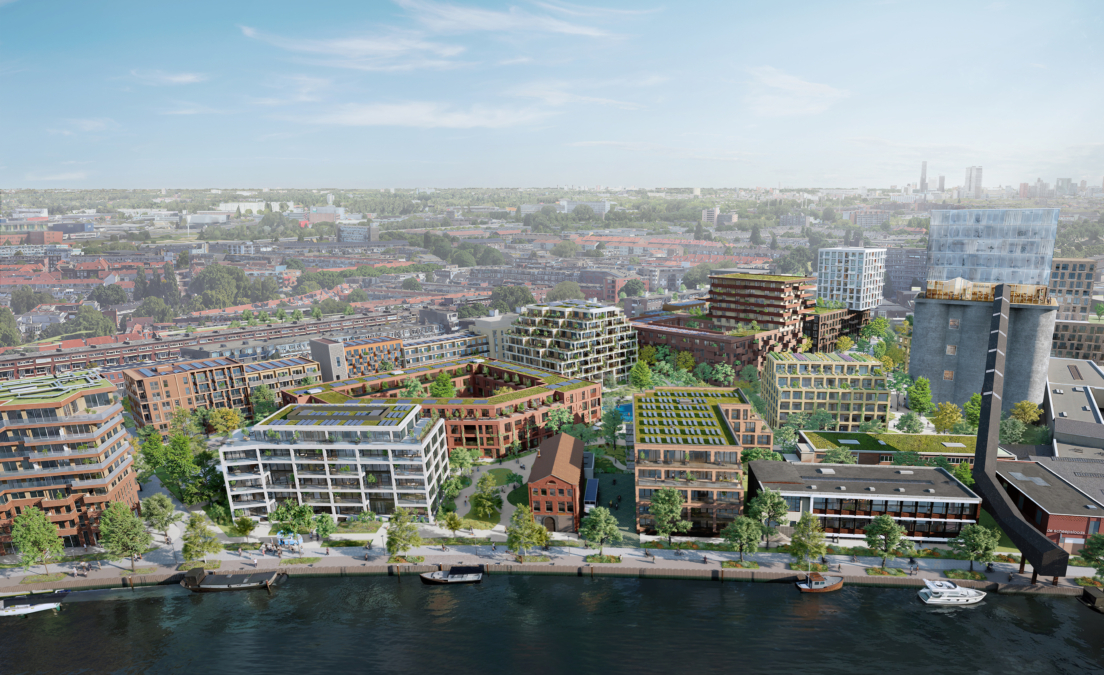
The Glaspark forms a collective landscape that brings together industrial heritage, ecology, and urban vitality.
Urban Nature as a Collective Foundation
The planting strategy reinforces this character through a layered system of trees, shrubs, and herbaceous vegetation. Ecology is not an addition to the design but its starting point. The robust green structure supports biodiversity, enhances climate resilience, and brings seasonal change into the heart of the development. Under both wet and dry conditions, a resilient urban ecosystem emerges that adapts to its surroundings.
The result is a new urban living environment in which the landscape is not the backdrop to development, but its foundation. The Glaspark connects residents, nature, water, and the city within one integrated system, giving the former glass factory site a new future.
Interview in collaboration with https://www.deglasfabriek.com
- Location
- Schiedam
- Status
- DO
- Client
- Blauwhoed, Dudok Real Estate
- Together with
- Barcode, Antea group en Ecoresult